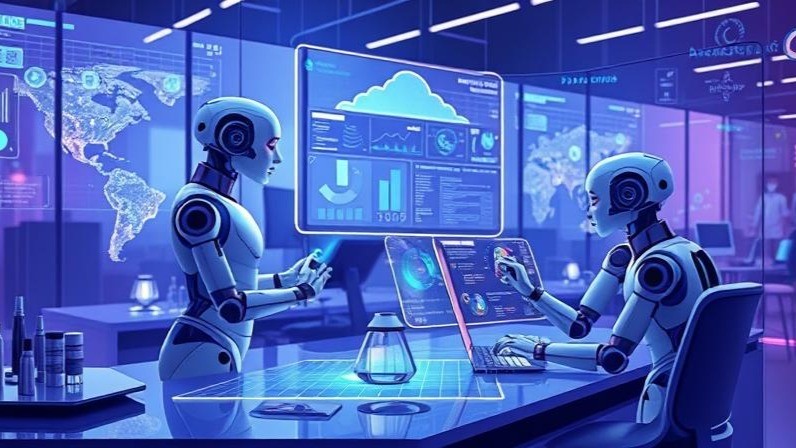
From personal assistants to entire virtual teams, AI agents are reshaping how businesses operate — and forcing us to rethink what “having a job” really means.
The age of AI chatbots answering simple questions is over. In 2025, the world has entered the era of AI agents — autonomous software entities that perform complex tasks, collaborate, and make decisions on behalf of humans.
These digital workers can now negotiate contracts, manage calendars, execute marketing campaigns, and even code new software. A marketing firm in New York recently revealed that 30% of its operational work is now handled by AI agents that run 24/7 — without salaries, sick days, or human burnout.
The implications are staggering. Companies are experimenting with “hybrid teams,” where human employees oversee fleets of AI colleagues. Managers are learning to assign projects to algorithms, not just people.
“AI agents are not tools — they’re coworkers,” says tech ethicist Dr. Reza Nouri. “And that changes workplace culture, accountability, and the very nature of labor.”
Yet the excitement is mixed with anxiety. Labor unions are calling for policies to protect human workers from total displacement, while regulators debate whether AI agents should be given “digital IDs” for traceability and liability.
At the same time, startups are building platforms where anyone can hire an AI agent as easily as ordering food online — creating an emerging “digital gig economy.” Imagine hiring a virtual assistant who handles your taxes, negotiates your bills, and even pitches investors — all without human supervision.
This shift could democratize productivity — or deepen inequality. Those who know how to build, train, and command these agents will thrive. Those who don’t risk being replaced by them.
The future of work, then, might not be humans versus AI — but humans who can multiply themselves through AI.
As AI agents evolve from task-doers to collaborators, one thing is certain: the workplace of 2030 will look nothing like the one we knew in 2020.